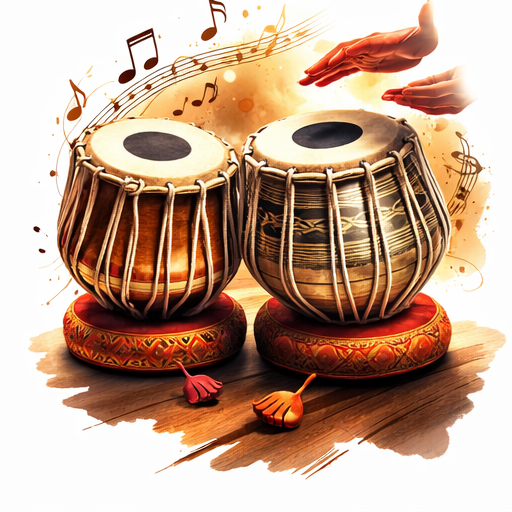
The tabla is a pair of hand drums central to North Indian (Hindustani) classical music. It consists of two drums: the larger left‑hand drum called bayan, traditionally made from clay but now commonly crafted from metal (brass, steel or copper), and the smaller right‑hand drum called dahina, made of seasoned hardwood. Each drum has two layers of goatskin and a circular patch of iron and rice paste known as shyahi on the head, which allows a wide palette of tones. Tension is controlled with goatskin straps and tuning blocks; the dahina is tuned to the tonic pitch of the composition, while the bayan is tuned more flexibly. Players use their fingers and palms to produce intricate rhythms and pitch bends.
| Family | Membranophone (Percussion) |
|---|---|
| Components | Bayan (bass drum) and Dahina (treble drum) |
| Materials | Metal or clay for bayan; hardwood for dahina; goatskin heads with iron‑rice paste |
| Playing method | Played with fingers and palm; pitch tuned via tension and hand pressure |